
Classic · Monuments
Abu Simbel 2026: the sun in the sanctuary, dates and times
Great Temple, Egypt
Next date UTC+3
What happens
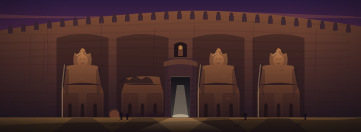
The axis runs at 101° from north: the rising sun falls into it while its height is between 0.5° and 6.0°. Outside that band the alignment does not close. The light falls on the statues of Ramesses II, Amun-Ra and Ra-Horakhty at the back of the sanctuary, while Ptah, a god linked to the underworld, always stays in the dark.
Next dates
Local times at the site (Africa/Cairo).
-
06:53 UTC+3
Published dates: 22 October (Sun Festival)
-
06:22 UTC+2
Published dates: 22 February (Sun Festival)
-
06:53 UTC+3
Published dates: 22 October (Sun Festival)
-
06:23 UTC+2
Published dates: 22 February (Sun Festival)
-
06:53 UTC+3
Published dates: 22 October (Sun Festival)
-
06:23 UTC+2
Published dates: 22 February (Sun Festival)
-
06:54 UTC+3
Published dates: 22 October (Sun Festival)
-
06:22 UTC+2
Published dates: 22 February (Sun Festival)
-
06:53 UTC+3
Published dates: 22 October (Sun Festival)
Where to stand
Viewpoint: Hypostyle hall · Great Temple, Egypt
22.33720, 31.62580
Look towards 101° from north.
Good to know
You queue to enter the hypostyle hall: huge crowds, arrive 60–90 minutes early, ticket needed. The light stays in the sanctuary for 20–25 minutes.
These are two different things. The statues at the back of the sanctuary are fully lit on three or four mornings, around 20–22 February and 20–22 October: the days documented since the temple was moved (Weyburne, 2021), carried over the leap-year cycle. It is a minimum, not a maximum. For a dozen mornings around them the light still gets into the temple, but at the edges it reaches only part of the sanctuary: on 23 October 2017 only part of Ramesses’ face was lit. Before the move the sanctuary was lit for 10 days, 13–22 October 1959. You often read that the move shifted the festival from the 21st to the 22nd; Weyburne puts that day down to three thousand years of drift. The 20–25 minutes of light come from press reports, not measurements. In October Egypt is still on daylight saving time (reintroduced in 2023, until the last Thursday of October): the effect starts around 07:00 on the clock, against about 06:20–06:30 in February. Many online sources quote “06:20” for both dates; the app’s times already allow for daylight saving.
Dates for 2026–2030, worked out by Duskbox’s own astronomy engine: the sun from NREL’s SPA, the moon topocentric, both with atmospheric refraction.