Classic · Cities
Sun through the Arc de Triomphe 2027: dates and times
Paris
Next date Obélisque · UTC+2
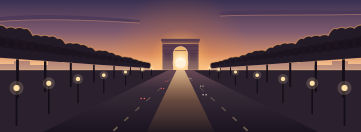
Obélisque
Sun · at set · Paris, place de la Concorde (obelisk)
The axis runs at 296° from north: the setting sun falls into it while its height is between 0.4° and 1.3°. Outside that band the alignment does not close.
Next dates
Local times at the site (Europe/Paris).
-
21:06 UTC+2
-
21:15 UTC+2
-
21:06 UTC+2
-
21:15 UTC+2
-
21:06 UTC+2
-
21:16 UTC+2
-
21:06 UTC+2
-
21:16 UTC+2
Where to stand
Viewpoint: Obélisque · Paris, place de la Concorde (obelisk)
48.86550, 2.32120
Lined up with Arc de Triomphe, 2.1 km away. Look towards 296° from north.
Good to know
At the foot of the obelisk, on the Champs-Élysées axis. From here the sun never fits whole in the arch. Around 8 May a large flag often hangs under it.
One metre sideways changes the azimuth by almost 2′: the date can slip by a day if you are not exactly on the axis. The top of the Grande Arche at La Défense cuts across the opening.
Rond-point Clemenceau
Sun · at set · Paris, Rond-point des Champs-Élysées
The axis runs at 296° from north: the setting sun falls into it while its height is between 1.0° and 2.2°. Outside that band the alignment does not close.
Next dates
Local times at the site (Europe/Paris).
-
21:04 UTC+2
-
21:14 UTC+2
-
21:04 UTC+2
-
21:14 UTC+2
-
21:04 UTC+2
-
21:14 UTC+2
-
21:04 UTC+2
-
21:14 UTC+2
Where to stand
Viewpoint: Rond-point Clemenceau · Paris, Rond-point des Champs-Élysées
48.86760, 2.31400
Lined up with Arc de Triomphe, 1.6 km away. Look towards 296° from north.
Good to know
On the central island of the Rond-point, in the middle of the traffic: IMCCE’s ideal point, but awkward and crowded.
From here the whole sun fits in the arch, but a metre sideways moves the azimuth by more than 2′: the date can slip by a day.
Dates for 2026–2030, worked out by Duskbox’s own astronomy engine: the sun from NREL’s SPA, the moon topocentric, both with atmospheric refraction.