Classic · Monuments
Stonehenge 2027: dates and times
Wiltshire
Next date Circle centre · UTC+1
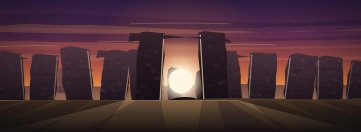
Circle centre
Sun · at rise · Wiltshire, England
The axis runs at 50° from north: the rising sun falls into it while its height is between -0.3° and 3.0°. Outside that band the alignment does not close.
Next dates
Local times at the site (Europe/London).
-
04:52 UTC+1
-
04:52 UTC+1
-
04:52 UTC+1
-
04:52 UTC+1
Where to stand
Viewpoint: Circle centre · Wiltshire, England
51.17890, -1.82620
Lined up with Heel Stone, 0.08 km away. Look towards 50° from north.
Good to know
Inside the circle only on English Heritage “managed access” days, with booked and often sold-out parking. Look north-east, over the Heel Stone.
Near the solstice the sun’s direction barely changes from one day to the next: the effect is almost identical for several days, and the peak date is best read as the middle of a window.
Heel Stone
Sun · at set · Wiltshire, from the Heel Stone
The axis runs at 230° from north: the setting sun falls into it while its height is between -0.3° and 3.0°. Outside that band the alignment does not close.
Next dates
Local times at the site (Europe/London).
-
15:49 UTC
-
15:49 UTC
-
15:49 UTC
-
15:49 UTC
-
15:49 UTC
Where to stand
Viewpoint: Heel Stone · Wiltshire, from the Heel Stone
51.17940, -1.82540
Look towards 230° from north.
Good to know
English Heritage’s winter gathering is at sunrise, but the real alignment is at sunset, from the Heel Stone looking south-west: the site closes early, check the hours.
Near the solstice the sun’s direction barely changes from one day to the next: the effect is almost identical for several days, and the peak date is best read as the middle of a window.
Dates for 2026–2030, worked out by Duskbox’s own astronomy engine: the sun from NREL’s SPA, the moon topocentric, both with atmospheric refraction.